Showing posts with label Activities. Show all posts

Sunday, December 31, 2017

Books About Unsung Heroes


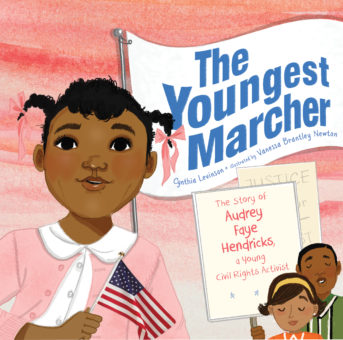
It is rare to have a book about a child involved in the Civil Rights struggle. Here is one:
THE YOUNGEST MARCHER : the Story of Audrey Faye Hendricks, a young Civil Rights Activist by Cynthia Levinson.

Here is a sample: "Whenever Mike flew into town Audrey and her momma coo-cooked! [sic] Barbecued ribs, stewed greens, sweet potato souffle, and Audrey's favorite--hot rolls baptized in butter."

Who was Mike? That was the nickname for the Reverend Dr. Martin Luther King, Jr.

This would be a good title for Black History Month. Teachers could have their students write and perform a skit. Students could write their own story about Audrey.

Cynthia provides resources for teachers.

Wednesday, September 13, 2017

Just a Minute


Since a new school year has started, I have decided to concentrate on interesting titles for the class room. My first one is called JUST A MINUTE : a Trickster Tale and Counting Book by Yuyi Morales.

 First grade teachers, this book works on a number of levels. First, it tells a story.

Here's a sample: "Senior Calavera tipped his hat. What a skinny gentleman! With a pass of his hand he signaled to Grandma Beetle."

Numbers one to ten are embedded in the story and are repeated in Spanish. It's a chance  for students to learn to count to ten in English and Spanish.

Saturday, October 31, 2015

Put Yourself in Phillis Wheatley's Shoes


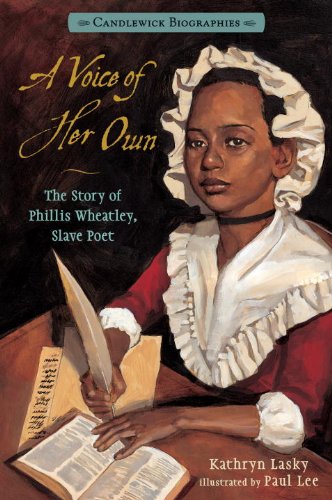
A VOICE OF HER OWN: the story of Phillis Wheatley, Slave Poet by Kathryn Lasky is a picture book biography of Phyllis Wheatley that would be good for grades 3-5.

It has more information than the shorter picture book biographies which is important for school projects.

Take this sample which brings the reader into the mindset of a slave.

“At first there was just blackness….. Then the blackness dissolved into darkness, and the world in the creaking hold of the slave ship slid with shadows.”

Teachers, here’s  possible school assignments for Black History Month.

Have your students write a play about how a slave would feel on one of these ships .What smells would they encounter? What sounds? What would it feel like to be chained up?


Have your students write poems with Phillis Wheatley as the subject.

Sunday, August 9, 2015

Voyage to the Moon


A different kind of travel is depicted in MOONSHOT : the Flight of Apollo 11, a nonfiction picture book by Brian Floca.

What did the astronauts experience?

SAMPLE: "Onboard Columbia and Eagle, Armstrong, Collins, Aldrin  unclick gloves, unclick helmets, unclick the straps that hold them down, and float inside their small ships, their home for a week."

This repetition is very effective. Everybody is familiar with the unclicking of seatbelts in cars. The reader can relate to this.

For a summer activity Brian Floca has provided coloring pages from MOONSHOT.

Friday, July 31, 2015

TAKE A TRIP TO ANCIENT CHINA

At Home in Her Tomb book cover image
AT HOME IN HER TOMB: Lady Dai and the Ancient Chinese Treasures of Mawangdui by Christine Liu-Perkins. Great adventures awaited the workers who uncovered the tomb of an ancient Chinese noblewoman named Lady Dai. In addition to finding treasures they uncovered a huge black coffin. Inside that coffin there was another one. They didn’t find the occupant until they reached the fourth coffin.

To their surprise, a stench greeted them when they cut a hole in the silk cloth that surrounded the body.

SAMPLE: “The experts were baffled. If the body had decomposed more than two thousand years ago, how could it still smell so disgusting?”

Join the scientists on their journey to uncover the contents of  Lady Dai’s tomb. What was her last meal? What artifacts accompanied her on her final journey?

Readers can visit the web site of the Hunan Provincial Museum, the home of these archaeological treasures.

Teachers can find a guide to use with their students.

This is a useful book for classroom projects on China.


Sunday, July 26, 2015

Why Black Girls Should Become Ballerinas


Ballet is a form of dance that attracts few African Americans. Two African American ballerinas would like to change that and both of them wrote books.

FIREBIRD by Misty Copeland is really an essay in picture book form. The subtitle is Ballerina Misty Copeland shows a young girl how to dance like the firebird, character in a famous ballet.

Misty tells a potential ballerina of color what ballet means to her.

Sample: “you will soar become a swan, a beauty, a firebird for sure.” 

One illustration in this book demonstrates the five positions of ballet.

Today Misty is a principal dancer for the American Ballet Theatre.


Ballerina Dreams: From Orphan to Dancer (Step Into Reading, Step 4)


BALLERINA DREAMS by Michaela and Elaine DePrince  is a biography reader in the STEP INTO READING  series.

Michaela DePrince is an orphan from Sierra Leone who was adopted by an American couple.

She told her new mother that she wanted to study ballet. Her mother bought her a video of the ballet The Nutcracker.

Michaela began her dance lessons. When she was eight years old she was able to audition for The Nutcracker. She won two roles in the ballet. Eventually she danced the role of The Sugar Plum Fairy, an important roll. She is now a professional ballerina.

Sample: “The music begins, and my heart beats fast with excitement. I fly on to the stage.”

This book gives definitions of ballet terms such as combinations: putting ballet steps together.  

Activity

Write definitions for these ballet terms:

Firebird

The Nutcracker

Sugar Plum Fairy

Ballet barre

Port de bras

Tendu

Five positions

Plie

Combination

Grand jete

Pas de cat


En pointe
Sunday, June 28, 2015

Ode to Imagination


MY PEN by Christopher Myers  shows how his pen takes him on journeys. Christopher illustrates books and uses his imagination.

Sample: "My pen rides dinosaurs and hides an elephant in a teacup."

Christopher wants you to use your pen and see what worlds will come out.

Activity:  Using crayons picture an imaginary world. It could be anywhere. On another planet. A country you just made up. Draw what people or animals might look like. Does it have lakes or oceans?

Tuesday, May 19, 2015

Trombone Shorty


TROMBONE SHORTY by Troy Andrews is a picture book biography of his growing up in New Orleans and the importance of music in his life. One day he found a broken trombone.
Sample: “The next time the parade went by my house, I grabbed that trombone and headed out into the street. My brother James noticed me playing along and smiled proudly. ’Trombone Shorty!’ he called out, because the instrument was twice my size.”

Activity:
Make your own musical instrument like Trombone Shorty did.

He made a drum from a 12 pack soda box and used pencils for drumsticks. He used empty soda bottles as wind instruments.   

Sunday, April 26, 2015

Insects Who Eat Poop


Behold the Beautiful Dung Beetle by Cheryl Bardoe is a science picture book that will delight kids and gross out their parents. These beetles live on the poop of animals (but not their own.)

Sample: "For these beetles, dung is a precious pile of food and drink."

Readers will learn that there are three types of dung beetles, each with a special way of eating feces: dwellers, rollers and tunnelers.

This book  has a fascinating facts section, glossary, and selected bibliography.

Activity:
Locate dung beetles by looking under cow patties or deer droppings but as the author warns, wear gloves, so you don't get sick from the bacteria that live in dung and wash your hands afterwards.

Saturday, January 10, 2015

GOLDIE TAKES A STAND


Let’s say that you want to write a picture book about a historical event but you have only the briefest information available. What do you do?
You can follow the example of Barbara Krasner who wrote Goldie Takes a Stand: Golda Meir’s First Crusade. She wrote a book on an incident from Golda’s childhood. Poor children couldn’t afford books so Golda helped raise money for them.  Barbara’s only documented information was a newspaper clipping. She invented first person dialogue, which makes this book biographical fiction. But still a learning tool.
Sample: “Will the meeting come to order?” I announced to the girls crowded into our two-room Walnut Street apartment.”
What does this tell us about Golda? That she was a take-charge person.
That she lived in a crowded apartment.
ACTIVITY
Take any historical figure that interests you. Pick an event from that person’s life. Write a skit imagining the conversation that could have gone on during that event. Answer these questions: Who else was there? What did the event accomplish?

Sunday, January 4, 2015

MISS MOORE THOUGHT OTHERWISE


MISS MOORE THOUGHT OTHERWISE

By Jan Pinborough

 Anne Carroll Moore ran the Central Children’s Room at the New York Public Library and was responsible for making the children’s room inviting for the child patron. This picture book biography will introduce the reader to the important contributions she made.

Sample: “She gathered collections of shells and butterflies to display. Then she filled the shelves with the very best children’s books she could find.”

Activities

1. Miss Moore had a wooden doll named Nicholas Knickerbocker she used during story hours.

Pretend that Nicholas could talk and was interviewing a child who had just immigrated to the U.S. and was at his or her first story hour.

What questions would Nicholas ask the child about his or her life?

What country the child came from? What customs from that  country did the child  especially like?

Pick one and write a paragraph about one of them using the Who, What, Where, When of journalism.