Showing posts with label Biographies. Show all posts

Sunday, March 25, 2018

An Effective Use of Quotes


I admire Doreen Rappaport's use of quotes in her picture book biography, Jack's Path of Courage: the Life of John F. Kennedy.  

 Here's a line of text: "Jack's mother read to her children every night;" Underneath that was a direct quote from Jack's mother: "He always read more than any of the others."

The book includes quotes from Jack's father and Jack himself.

Rather than a slice of life approach this book starts with his childhood and ends with his death. In this case, it is appropriate. Students might be asked the date of his death and the information is right at hand.

Tuesday, October 3, 2017

A Good Book About Lena


In looking at THE LEGENDARY MISS LENA HORNE by Carole Boston Weatherford as a mentor text I made some observations.

It begins with family information. “The Horne family tree was laden with achievers: teachers, activists, a Harlem Renaissance poet…..”

Then it becomes a birth, childhood and career narrative but not the cradle to grave approach.

I recently attended a webinar on page turns and examined their role in nonfiction picture books.

For example: one two-page spread ends this way: “With Sissle, eighteen-year-old Lena cut her first record…”

The following two-page spread has her fronting a band.

Does that page turn encourage the reader to turn the page?

The jacket flap says it is for ages 4-8 but I think it would be a great fit for the elementary grades where they are studying Women’s History Month and Black History Month.


Teachers, keep this title in mind.  


Tuesday, May 9, 2017

An Analytical Look at a Middle Grade Nonfiction Book


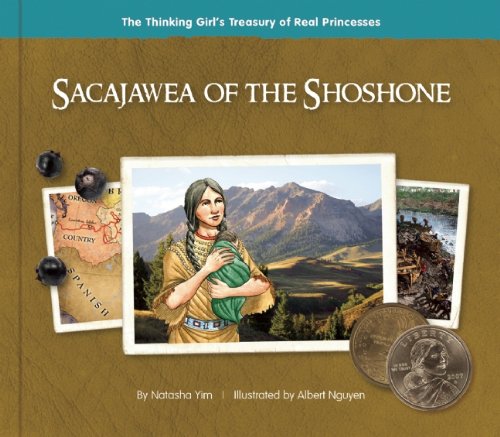
Sometimes  you might think you are looking at a picture book but it actually turns out to be  middle grade nonfiction.  For example, SACAJAWEA OF THE SHOSHONE by Natasha Yim has 28 numbered pages with a bibliography on the end papers. This title is part of a series : THE THINKING GIRL'S TREASURY OF REAL PRINCESSES. Sacajawea, who accompanied Lewis and Clark on their exploration of the American West, was a Princess of the Shoshone Tribe.

This biography can also be classed as narrative nonfiction because of the moments of drama.
Here's an example: "One day, a violent gust of wind tipped the pirogue carrying Sacajawea and her family. Fortunately the boat didn't capsize, but it quickly filled with water.....Sacajawea....calmly scooped [important papers, books, trading goods] up."

Sacajawea prevented needed items from floating away. Otherwise the expedition would have had to turn back.

Sidebars provide information about her clothing and the food she ate, as well as how her name was pronounced.


Sunday, January 4, 2015

MISS MOORE THOUGHT OTHERWISE


MISS MOORE THOUGHT OTHERWISE

By Jan Pinborough

 Anne Carroll Moore ran the Central Children’s Room at the New York Public Library and was responsible for making the children’s room inviting for the child patron. This picture book biography will introduce the reader to the important contributions she made.

Sample: “She gathered collections of shells and butterflies to display. Then she filled the shelves with the very best children’s books she could find.”

Activities

1. Miss Moore had a wooden doll named Nicholas Knickerbocker she used during story hours.

Pretend that Nicholas could talk and was interviewing a child who had just immigrated to the U.S. and was at his or her first story hour.

What questions would Nicholas ask the child about his or her life?

What country the child came from? What customs from that  country did the child  especially like?

Pick one and write a paragraph about one of them using the Who, What, Where, When of journalism.

Sunday, June 15, 2014

A Really Cool Inventor


The Coolest Inventor: Willis Haviland Carrier and His Air Conditioner by Alison and Stephen Eldridge

Here's a snippet: "When Willis was in school, he had trouble understanding math with fractions. His mother had him cut up apples to work out problems with them. This taught Willis that he could solve problems if he just broke them down into simple pieces."


This book gives steps for young inventors to take  when they get a great idea.
It also includes a timeline, a glossary called words to know, books and websites, and an index.

Sunday, January 20, 2013

The Men Behind the Science of Temperature


Whenever we feel ill, we have our temperature taken by a thermometer.

In the United States we use fahrenheit to measure temperature. In other parts of the world they use celsius.

Meet the men behind these temperature scales in Fahrenheit, Celsius, and Their Temperature Scales by Yoming S. Lin.

They are named Daniel Gabriel Fahrenheit and Anders Celsius.

Here is a sample: " Daniel Gabriel Fahrenheit invented a thermometer that was better than earlier ones....Anders Celsius created another temperature scale. This is the scale that scientists use today."

This joint biography tells about their work and includes other useful features: Inside the Science gives some facts about the subject of measuring temperature. A glossary and index  are included.

This title would be useful in Common Core Science Standards.


Sunday, January 13, 2013

Literary Criticism and Book Reports


Literary criticism is something that can be incorporated into book reports even for grades 4-8. I recently read a book that is a candidate for this:
Suzanne Collins by Diane Bailey.

Not only is it a biography but it also  offers commentary on her Underland series, as well as The Hunger Games.

Here is a sample: "When Collins addressed the difficult problems of war in the Underland Chronicles, she raised the stakes in the Hunger Games trilogy. This time, it wasn't humans fighting giant insects. It wasn't even adults fighting adults. This time it was children fighting children."

This book contains a useful bibliography as well.