Showing posts with label Picture books. Show all posts

Sunday, March 29, 2020

MONUMENT MAKER


MONUMENT MAKER : Daniel Chester French and the Lincoln Memorial is a nonfiction picture book about  connections. As the first spread says, “history shapes our lives. And what we do with our lives can shape history.”

Daniel was a boy during the Civil War, but his brother Will joined the war effort.
When Abraham Lincoln was shot Dan and his classmates wore black bands on their sleeves in his honor.

Although Dan came from a family of lawyers, sculpting was his contribution to history.

The author, Linda Booth Sweeney's connection to Dan was showing an artist who persevered to become a master of his craft and honoring his celebration of Abraham Lincoln. Her planning this book using illustrations was central to her process.

“Where possible, I  imagined each spread as a scene.  Page turns were the signal to the reader one scene was ending and another was about to begin,” she said.

Teachers might consider using the illustrations for writing assignments. Put yourself  in Dan’s shoes. What would you have done if you had been Dan?  

And if you're a student whose family planned to visit the Lincoln Memorial this summer but might not, read Linda's book instead!


Wednesday, October 18, 2017


Here is an inspiration to young girls everywhere, I DISSENT: Ruth Bader Ginsburg Makes Her Mark by Debbie Levy.

 Girls can relate to this snippet: "In elementary school, Ruth was excellent in some classes--and less excellent in others. Her favorites were English, history, and gym."

The book details the many ways she protested on her way to becoming Supreme Court Justice.

This is a good title for Women's History Month.

Wednesday, September 13, 2017

Just a Minute


Since a new school year has started, I have decided to concentrate on interesting titles for the class room. My first one is called JUST A MINUTE : a Trickster Tale and Counting Book by Yuyi Morales.

 First grade teachers, this book works on a number of levels. First, it tells a story.

Here's a sample: "Senior Calavera tipped his hat. What a skinny gentleman! With a pass of his hand he signaled to Grandma Beetle."

Numbers one to ten are embedded in the story and are repeated in Spanish. It's a chance  for students to learn to count to ten in English and Spanish.

Thursday, October 8, 2015

Why Birds Need Feathers


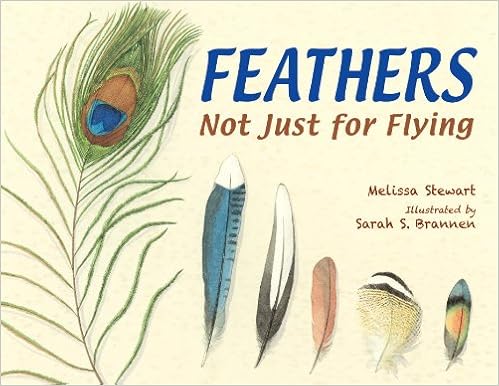
Melissa Stewart is at it again in FEATHERS : NOT JUST FOR FLYING.  I can see many uses for this title in the classroom. Teachers can use it to show what the feathers of various bird species look like. Melissa thinks it can be used for grades K-5. (See her teacher's guide.) The break-down of text and illustration is very effective.

Let's examine one spread. On the left: "Feathers can warm like a blanket..." Under the illustration on that page is this text box "On cold, damp days a blue jay stays warm by fluffing up its feathers and trapping a laying of warm air next to its skin."

A full page illustration of a blue jay appears on the next page.

Each spread illustrates the various ways birds use feathers.

Melissa explains her process in her author's note.

Sunday, August 9, 2015

Voyage to the Moon


A different kind of travel is depicted in MOONSHOT : the Flight of Apollo 11, a nonfiction picture book by Brian Floca.

What did the astronauts experience?

SAMPLE: "Onboard Columbia and Eagle, Armstrong, Collins, Aldrin  unclick gloves, unclick helmets, unclick the straps that hold them down, and float inside their small ships, their home for a week."

This repetition is very effective. Everybody is familiar with the unclicking of seatbelts in cars. The reader can relate to this.

For a summer activity Brian Floca has provided coloring pages from MOONSHOT.

Sunday, July 26, 2015

Why Black Girls Should Become Ballerinas


Ballet is a form of dance that attracts few African Americans. Two African American ballerinas would like to change that and both of them wrote books.

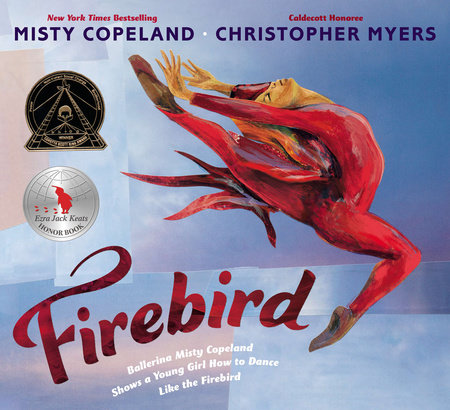
FIREBIRD by Misty Copeland is really an essay in picture book form. The subtitle is Ballerina Misty Copeland shows a young girl how to dance like the firebird, character in a famous ballet.

Misty tells a potential ballerina of color what ballet means to her.

Sample: “you will soar become a swan, a beauty, a firebird for sure.” 

One illustration in this book demonstrates the five positions of ballet.

Today Misty is a principal dancer for the American Ballet Theatre.


Ballerina Dreams: From Orphan to Dancer (Step Into Reading, Step 4)


BALLERINA DREAMS by Michaela and Elaine DePrince  is a biography reader in the STEP INTO READING  series.

Michaela DePrince is an orphan from Sierra Leone who was adopted by an American couple.

She told her new mother that she wanted to study ballet. Her mother bought her a video of the ballet The Nutcracker.

Michaela began her dance lessons. When she was eight years old she was able to audition for The Nutcracker. She won two roles in the ballet. Eventually she danced the role of The Sugar Plum Fairy, an important roll. She is now a professional ballerina.

Sample: “The music begins, and my heart beats fast with excitement. I fly on to the stage.”

This book gives definitions of ballet terms such as combinations: putting ballet steps together.  

Activity

Write definitions for these ballet terms:

Firebird

The Nutcracker

Sugar Plum Fairy

Ballet barre

Port de bras

Tendu

Five positions

Plie

Combination

Grand jete

Pas de cat


En pointe

Sunday, April 26, 2015

Insects Who Eat Poop


Behold the Beautiful Dung Beetle by Cheryl Bardoe is a science picture book that will delight kids and gross out their parents. These beetles live on the poop of animals (but not their own.)

Sample: "For these beetles, dung is a precious pile of food and drink."

Readers will learn that there are three types of dung beetles, each with a special way of eating feces: dwellers, rollers and tunnelers.

This book  has a fascinating facts section, glossary, and selected bibliography.

Activity:
Locate dung beetles by looking under cow patties or deer droppings but as the author warns, wear gloves, so you don't get sick from the bacteria that live in dung and wash your hands afterwards.